


My Store
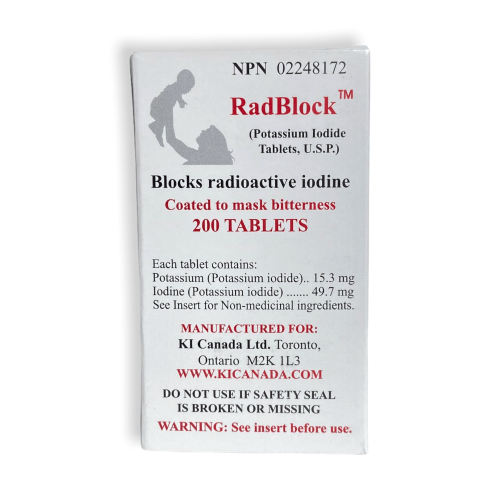
Buy RadBlock 200 Coated Scored Potassium Iodide Tablets : Expire 2034
Buy RadBlock 200 Coated Scored Potassium Iodide Tablets : Expire 2034
Couldn't load pickup availability
We have been producing Health Canada-approved RadBlock 200 Potassium Iodide since 2003. We are the suppliers to Ontario Power Generation Bruce Power and the Canadian Government
RADBLOCK 200 65MG SCORED COATED TABLET
Expires 2034
Best value for the protection of the thyroid during a nuclear emergency.
Recommended purpose or use:
Thyroid blocking agent for use in a nuclear emergency involving the release of radioiodine. This medication is to be used in addition to measures to avoid exposure to radiation such as evacuation, shelter, and agricultural and food measures to limit the sale and ingestion of radioiodine-contaminated food.
Each tablet contains:
Potassium (Potassium iodide) 15.3 mg
Iodine (Potassium iodide) 497 mg
(The tabled information is provided courtesy of the Nuclear Regulatory Commission). |
||||||||||||||||||||||||||||||||
Frequently Asked Questions About Potassium Iodide
In Canada, Health Canada, or in the United States, the FDA, is the Federal agency responsible for decisions about appropriate thresholds and dosages for use of potassium iodide:
What is potassium iodide?
Potassium iodide is a salt, similar to table salt. Its chemical symbol is KI. It is routinely added to table salt to make it 'iodized'. Potassium iodide,if taken in time and at the appropriate dosage, blocks the thyroid gland's uptake of radioactive iodine and thus could reduce the risk of thyroid cancers and other diseases that might otherwise be caused by exposure to radioactive iodine that could be dispersed by a terrorist activity or nuclear accident.
What is the role of potassium iodide in radiological emergency preparedness?
The purpose of radiological emergency preparedness is to protect people from the effects of radiation exposure after a dirty bomb or accident at a nuclear power plant. Evacuation is the most effective protective measure in the event of a radiological emergency because it protects the whole body (including the thyroid gland and other organs) from all radionuclides and all exposure pathways. However, in situations when evacuation is not feasible and in-place sheltering is substituted as an effective protective action, administering potassium iodide is a reasonable, prudent, and inexpensive supplement to evacuation and sheltering.
Potassium iodide is a special kind of protective measure in that it offers very specialized protection. Potassium iodide protects the thyroid gland against internal uptake of radioiodines that may be released in the unlikely event of nuclear exposure.
What is the benefit of taking potassium iodide during a radiological accident?
When potassium iodide is ingested, it is taken up by the thyroid gland. In the proper dosage, and taken at the appropriate time, it will effectively saturate the thyroid gland in such a way that inhaled or ingested radioactive iodines will not be accumulated in the thyroid gland. The risk of thyroid effects is reduced. Such thyroid effects resulting from radioiodine uptakes due to inhalation or ingestion, or both, could result in acute, chronic, and delayed effects. Acute effects from high doses include thyroiditis, while chronic and delayed effects include hypothyroidism, thyroid nodules, and thyroid cancer.
Can individual members of the public obtain potassium iodide?
Health Canada has approved potassium iodide as an over-the-counter medication. As with any medication, individuals should check with their doctor or pharmacist before using it.
What are the recommended dosages of potassium iodide?
Please see the chart shown above.
- Availability: In Stock
- Model:RB200
Accidents at Nuclear Power Plants and Cancer Risk
What is ionizing radiation?
Ionizing radiation consists of subatomic particles (that is, particles that are smaller than an atom, such as protons, neutrons, and electrons) and electromagnetic waves. These particles and waves have enough energy to strip electrons from, or ionize, atoms in molecules that they strike. Ionizing radiation can arise in several ways, including
- from the spontaneous decay (breakdown) of unstable isotopes. Unstable isotopes, which are also called radioactive isotopes, give off (emit) ionizing radiation as part of the decay process. Radioactive isotopes occur naturally in the Earth’s crust, soil, atmosphere, and oceans. These isotopes are also produced in nuclear reactors and nuclear weapons explosions.
- from cosmic rays originating in the sun and other extraterrestrial sources and from technological devices ranging from dental and medical x-ray machines to the picture tubes of old-style televisions
Everyone on Earth is exposed to low levels of ionizing radiation from natural and technological sources in varying proportions, depending on their geographic location, diet, occupation, and lifestyle.
What are the health hazards of exposure to ionizing radiation?
At high doses, ionizing radiation can cause immediate damage to a person’s body, including, at very high doses, radiation sickness and death. At lower doses, ionizing radiation can cause health effects such as cardiovascular disease and cataracts, as well as cancer. It causes cancer primarily because it damages DNA, which can lead to cancer-causing gene mutations.
Children and adolescents can be more sensitive to the cancer-causing effects of ionizing radiation than adults because their bodies are still growing and developing. Also, children and adolescents usually have more years of life following radiation exposure during which cancer may develop.
More information about the health effects of ionizing radiation exposure is available from the Centers for Disease Control and Prevention (CDC) and the Environmental Protection Agency.
How are people exposed to ionizing radiation after a nuclear power plant accident?
Nuclear power plants use energy released by the decay of certain radioactive isotopes to produce electricity. Additional radioactive isotopes are produced during this process. In nuclear power plants, specially designed fuel rods and containment structures enclose the radioactive materials to prevent them, and the ionizing radiation they produce, from contaminating the environment. If the fuel and surrounding containment structures are severely damaged, radioactive materials and ionizing radiation may be released, potentially posing a health risk for people. The actual risk depends on
- the specific types and quantities of radioactive materials, or isotopes, released
- how much radiation someone is exposed to and for how long
- how a person comes in contact with the released radioactive materials (such as through contaminated food, water, air, or on the skin)
- the person’s age (with those exposed at younger ages generally at higher risk of cancer)
The radioactive isotopes released in nuclear power plant accidents include iodine-131 (I-131), cesium-134 (Cs-134), and Cs-137. In the most severe kinds of accidents, such as the Chernobyl accident in 1986, other dangerous radioactive isotopes, such as strontium-90 (Sr-90) and plutonium-239, may also be released.
Human exposure to I-131 released from nuclear power plant accidents comes mainly from consuming contaminated water, milk, or foods. People may also be exposed by breathing dust particles in the air that are contaminated with I-131.
Inside the body, I-131 accumulates in the thyroid gland, which is an organ in the neck. The thyroid gland uses iodine to produce hormones that control how quickly the body uses energy. Because the thyroid does not distinguish between I-131 and nonradioactive iodine, the thyroid gland will accumulate either form. Exposure to radioactive iodine may increase the risk of thyroid cancer for many years, especially for children and adolescents.
Exposure to Cs-134 and Cs-137 can be external to the body or internal. External exposure comes from walking on contaminated soil or coming into contact with contaminated materials at nuclear accident sites. Internal exposure can come from breathing particles in the air that contain Cs-134 and Cs-137, such as dust originating from contaminated soil, or ingesting contaminated water or foods. Because Cs-134 and Cs-137 do not become concentrated in a particular tissue, the ionizing radiation that it releases can expose all tissues and organs of the body.
What have researchers learned about cancer risks from nuclear power plant accidents?
Much of what is known about cancer caused by radiation exposures from nuclear power plant accidents comes from research on the April 1986 nuclear power plant disaster at Chernobyl in Ukraine (Chornobyl in Ukrainian) (1, 2). The radioactive isotopes released during the Chernobyl accident included I-131, Cs-134, Cs-137, and Sr-90.
Power plant workers on-site at the time of the accident. Approximately 600 workers at the power plant during the emergency received very high doses of radiation and suffered from radiation sickness. All of those who received more than 6 grays (Gy) of radiation became very sick right away and subsequently died. Those who received less than 4 Gy had a better chance of survival. (A Gy is a measure of the amount of radiation absorbed by a person’s body.)
Cleanup workers. Hundreds of thousands of people who worked as part of the cleanup crews in the years after the accident were exposed to average external doses of ionizing radiation that ranged from approximately 0.14 Gy in 1986 to 0.04 Gy in 1989. Studies conducted in this group of people have found an increased risk of leukemia (3–5).
Residents near Chernobyl. From 1986 through 2005, approximately 5 million residents of the contaminated areas surrounding Chernobyl received an accumulated whole-body average dose of around 0.01 Gy (6). Studies that have followed children and adolescents exposed to I-131 from the Chernobyl accident showed an increased risk of developing thyroid cancer (7–9).
Recent studies have used genomic analysis of people affected by the Chernobyl accident to better understand how radiation exposure leads to cancer. In a 2021 study, investigators found that thyroid tumors in children who were exposed to fallout from the Chernobyl accident had higher levels of a particular kind of DNA damage that involves breaks in both DNA strands than tumors in unexposed individuals born more than 9 months after the accident (10). The more radiation the children had been exposed to, the more of this type of DNA damage was seen. This association was stronger the younger the children were at the time of exposure.
Another way in which radiation exposure could lead to cancer is through transgenerational effects, in which people exposed to ionizing radiation develop new genetic changes in their gametes (sperm or eggs) that are passed on to their future offspring, increasing cancer risk in those offspring. Transgenerational effects have been observed in some animal studies. However, genomic analysis of children born to people exposed to radiation at Chernobyl indicates that this exposure did not lead to an increase in new genetic changes in the children of exposed parents (11).
How long after exposure to I-131 is the risk of thyroid cancer increased?
Although the time it takes for the radiation to decrease by half (the half-life) of I-131 is only 8 days, the damage it causes can increase the risk of thyroid cancer for many years after the initial exposure.
A study led by NCI researchers followed more than 12,500 people who were younger than age 18 at the time they were exposed to a range of doses of I-131 (0.65 Gy on average) from the Chernobyl accident (7). A total of 65 new cases of thyroid cancer were found in this population between 1998 and 2007. The researchers found that the higher a person’s dose of I-131, the more likely they were to get thyroid cancer (with each Gy of exposure associated with a doubling of risk). They also found that this risk remained high for at least 30 years (9).
What can people do to protect themselves from health risks associated with exposure to contamination from a nuclear power plant accident?
Information on this topic is available from the CDC and other federal agencies.
What should cancer patients do if they live in an area that may be contaminated due to a nuclear power plant accident?
Share

FAQ
What is potassium iodide (KI) used for?
KI helps protect the thyroid from radioactive iodine during a radiation emergency, when directed by public health authorities.
How strong are these tablets?
Each tablet is 200 mg KI and is scored to help adjust dosing.
Who can take KI and how much?
Always follow public-health instructions. Dosing varies by age/weight and guidance.
Are the tablets coated?
Yes—coated for easier swallowing.
Storage & shelf life?
Store in a cool, dry place. Check label/package for expiration.
Is this medical advice?
No. Follow official guidance from public health authorities.